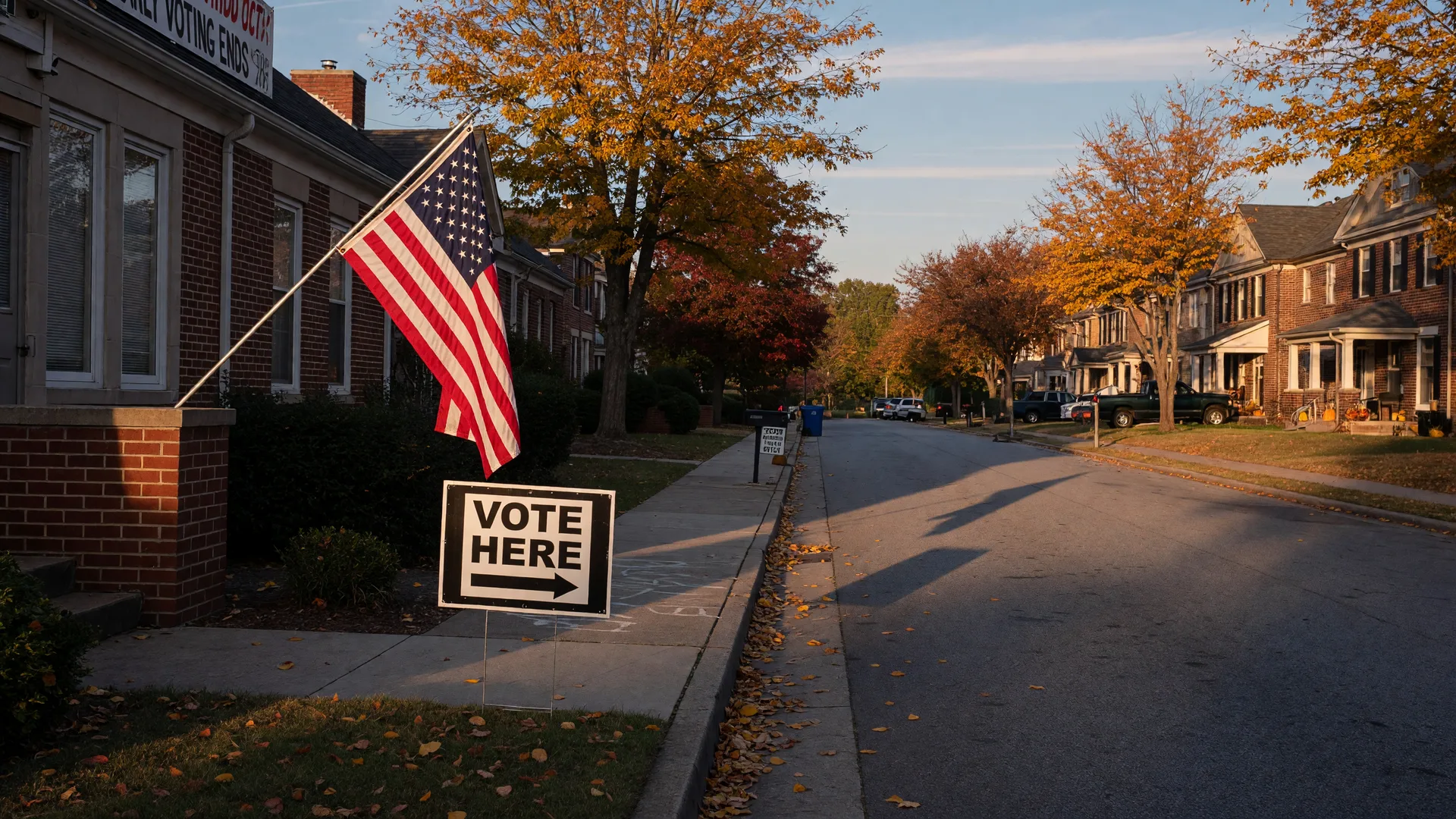
Georgia's general election is one week away, on Tuesday, November 3, 2026, and we have heard the question from clients in every one of our seven communities: should we wait to buy or sell until after the results are in? It is a natural thought. Elections feel uncertain, and big financial decisions during uncertain weeks feel risky. But the evidence, gathered over decades of election cycles, says something more calming: elections cause a brief lull in home sales, not a change in home prices, and the market recovers quickly after the votes are counted.
This article pulls together the historical research on elections and housing, plus the freshest verified numbers for NW Metro Atlanta: Freddie Mac's rate survey with the 30-year fixed at 7.32%, the Georgia MLS September recap with the metro median at $387,500, and inventory at its highest level in more than a decade. Everything below was verified this week. We are not here to tell you what to vote for. We are here to help you make a wise home decision regardless of the outcome.
Does the Election Actually Slow Home Sales?
What Do the Sales Numbers Show in Election Years?
Yes, briefly. The most-cited evidence comes from Meyer's Research, which studied new-home sales across 13 election years and found that median sales drop about 15% between October and November in election years, versus a typical seasonal drop of about 9.8% in non-election years. In plain terms: some buyers pause and wait for the outcome, and that pause shows up in the fall sales count.
The important part is what happens next. That same body of research, along with HUD and National Association of Realtors data, shows sales bounce back quickly after the election, usually in December and into the new year. Home sales increased in the year following 9 of the last 11 presidential elections since 1978; the only exceptions were 2000 and 2008, both caused by economic shocks (the dot-com bust and the financial crisis), not by the elections themselves. John Burns Research and Consulting, looking at 35 years of data, reached the same conclusion from the other direction: the annual seasonal decline in home sales is no worse in election years than in non-election years, and elections had little measurable impact on sales in the five months leading up to them.
The honest caveat: most of the published research focuses on presidential elections, because those draw the most attention. Midterm cycles follow the same pattern of a brief fall slowdown followed by a rebound, and the most recent midterm year, 2022, shows why the election itself is rarely the story. Home sales slowed in late 2022, but the reason was mortgage rates spiking from the mid-3s to over 6%, not the November ballot. This fall has its own version of that dynamic, which we will get to below.
Do Home Prices Drop in Election Years?
What Does Case-Shiller Data Show?
No, and this is the most reassuring part of the record. An analysis of the S&P CoreLogic Case-Shiller home price index found that homes appreciated an average of 4.84% per year in election years versus 4.44% per year in non-election years since 1987. In other words, election years have historically been marginally better for home prices, and in any case within the normal range. Prices are driven by supply, demand, affordability, and local job growth, not by who wins in November.
That is also the consensus among economists who study the question. Bright MLS chief economist Lisa Sturtevant has said the housing market does not look particularly different in presidential election years, because it is driven by demographics and the economy rather than elections. What changes around an election is sentiment and a temporary dip in activity, not value. A home is a long-term asset, and a few weeks of election headlines do not change its worth.
For NW Metro Atlanta specifically, the local fundamentals have not weakened. The metro median sale price held essentially flat year over year in September at $387,500, and the counties we serve range from about $358,700 in Bartow to about $470,000 in Cherokee. Nothing about a November election changes those drivers: jobs, schools, new construction, and the fact that people keep moving to this part of Georgia.
What Is Different About This Election Cycle in 2026?
What Are the Current Market Conditions in NW Metro Atlanta?
If an election pause is temporary, the conditions underneath it matter far more than the ballot. Here is where NW Metro Atlanta stands right now, with figures verified this week.
Mortgage rates: Freddie Mac's national 30-year fixed average eased to 7.32% for the week ending October 22, 2026, down eight basis points from 7.40%, the first decline in five weeks. The 15-year fixed averaged 6.68%, and a year earlier the 30-year averaged 6.19%. It is still the highest rate environment since November 2023, and neither Fannie Mae nor the Mortgage Bankers Association projects meaningful relief through 2027, with both forecasts keeping rates above 7%.
Prices: the Georgia MLS Atlanta MSA recap for September 2026 put the metro median sale price at $387,500, roughly flat year over year and down from August's $390,000. Closed sales fell 13.7% year over year to 4,072 units across the 12-county coverage, with about 4.7 months of supply. This is a slower, more balanced market than 2021 or 2022, not a falling market.
Inventory: this is the story of the fall. Active listings across the 12-county MSA rose to 23,006, up 5.3% year over year and the highest in more than a decade. The Atlanta Business Chronicle reported on October 15, 2026 that FMLS data showed about 21,053 homes for sale in September, the region's most in 13 years. Realtor.com data compiled for September 2026 found about 29% of metro Atlanta listings carried a price reduction, versus 20.8% nationally.
Put those three together and the picture is clear: buyers have the most selection and negotiating room in years, at the highest rates in three years. Sellers face a market that rewards honest pricing and sharp presentation. An election does not change any of it. Rates and inventory will decide this market long after the votes are counted.
What Is on the Ballot and When Can Georgians Vote?
When Is Election Day 2026 in Georgia?
Election Day for Georgia's 2026 general election is Tuesday, November 3, 2026, with polls open across the state from 7 a.m. to 7 p.m. Georgians vote on one of the state's two U.S. Senate seats, all 14 U.S. House seats, the Governor, Lieutenant Governor, Secretary of State, Attorney General, State School Superintendent, the Commissioners of Agriculture, Insurance, and Labor, a Public Service Commission seat, and every seat in the Georgia House and Senate. If no candidate clears the majority threshold in the statewide general, a runoff follows on December 1, 2026.
Many NW Metro Atlanta counties also have local referendums and races on the same ballot, from SPLOST transportation questions to county commission and school board seats, which matter to anyone choosing where to live. We do not endorse candidates, and this article is not about who to vote for. It is simply worth noting that many of the questions on the ballot affect the communities where our clients live: transportation, schools, and public safety shape home values over time, which is one more reason to vote, whatever your plans for your home.
Should Buyers Wait Until After the Election?
Is There a Real Advantage to Waiting?
Based on the evidence, no. The historical record shows that waiting for an election result does not change prices, and this fall's data gives buyers an unusual reason to act: the most inventory in more than a decade, with about 29% of listings carrying price cuts and Georgia closings typically running 30 to 45 days. A home under contract by mid-November can still close comfortably by the end of the year, before the holidays thin out the market.
The one thing that could change the math is mortgage rates, and the forecasts are not pointing down. Fannie Mae's October Housing Forecast projects the 30-year averaging about 7.4% in Q4 2026 and about 7.5% in 2027; the MBA sees rates above 7% through the end of 2027. If a buyer is waiting for both an election result and a rate drop, they may be waiting for something that never arrives this cycle. That is worth understanding before you park a decision on an election week.
For eligible first-time buyers, the math gets even better in the short term. The Georgia Dream program still offers a 30-year fixed rate of 6.750%, effective October 22, 2026, roughly half a point below the market, with down payment assistance as a 0% interest deferred second mortgage up to $10,000, or $12,500 under its PEN and CHOICE options for educators, nurses, first responders, and other qualifying buyers. Rates reset weekly on Thursdays, so timing matters, but the program is not going anywhere on November 4.
| The latest numbers at a glance | Figure | As of |
|---|---|---|
| Georgia Election Day 2026 | Tuesday, November 3 (polls 7 a.m. to 7 p.m.; runoff December 1 if needed) | 2026 general election |
| Typical election-year sales dip, October to November | About 15%, vs a 9.8% seasonal dip (Meyer's Research, 13 election years) | Historical |
| Average annual price appreciation in election years since 1987 | About 4.84%, vs 4.44% in non-election years (Case-Shiller) | Historical |
| Years home sales rose the year after a presidential election | 9 of the last 11 since 1978; only 2000 and 2008 fell, due to economic shocks | HUD / NAR data |
| Freddie Mac national 30-year fixed average | 7.32%, down 8 basis points week over week | Week ending October 22, 2026 |
| Metro Atlanta median sale price (Georgia MLS) | $387,500, roughly flat year over year | September 2026 |
| GAMLS 12-county active listings | 23,006, up 5.3% year over year, highest in more than a decade | September 2026 |
| Greater Atlanta homes for sale (FMLS) | About 21,053, highest in 13 years | September 2026 |
| Share of metro listings with price cuts | About 29%, vs 20.8% nationally | September 2026 |
| Georgia Dream first-time buyer 30-year fixed | 6.750%, DPA up to $10,000 (PEN/CHOICE $12,500) | Effective October 22, 2026 |
Sources: georgia.gov and the Georgia Secretary of State (2026 general election date and ballot); Meyer's Research election-year new-home sales analysis; S&P CoreLogic Case-Shiller index analysis as reported by NAR and Bankrate; HUD and NAR post-election sales data; John Burns Research and Consulting; Freddie Mac Primary Mortgage Market Survey (week ending October 22, 2026); Georgia MLS Atlanta MSA September 2026 recap; Atlanta Business Chronicle (October 15, 2026); Realtor.com September 2026 data; Georgia Department of Community Affairs, Georgia Dream program (effective October 22, 2026). All figures verified October 27, 2026.
Should Sellers List Before or After the Election?
Does a November Listing Really Matter?
For sellers, the election is even less of a factor, because the fall calendar was always going to shape November more than the ballot. Serious buyers are still out there, and in this market they tend to be more motivated than casual browsers. Homes under contract by early to mid-November can still close before the holidays, and buyers shopping during election week are usually decision-ready, not just looking.
What actually matters for a November listing is the same as any other month in 2026: honest, current pricing; sharp presentation; and a realistic timeline. With active listings at a 13-year high and about 29% of the metro's listings cutting price, a home priced against last spring will sit, and the market will correct it anyway, usually after burning the first weeks on market. A home priced for today's buyer, staged and photographed professionally, still gets showings and offers, and Cherokee County's steady pace is the proof.
One practical note for sellers this season: buyer financing is rate-sensitive in a 7.32% market, so build cushion into your timeline, and if you are buying your next home at the same time, talk early about a buy-before-you-sell plan so a timing gap does not capsize the move. Election week is not a reason to delay. The calendar, the rates, and the inventory are the reasons to move with intention.
The Bottom Line: What Should NW Metro Atlanta Families Do This Week?
The research is consistent across decades and cycles: elections cause a brief lull in home sales, not a change in home prices, and activity rebounds quickly after the votes are counted. Home values in election years have actually appreciated slightly faster than in non-election years on average, and sales rose in the year after 9 of the last 11 presidential elections. A November 3 ballot is not a reason to put your family's move on hold.
What is real this October is the market itself: rates at 7.32%, a metro median flat at $387,500, and more homes for sale than the region has seen in 13 years. For buyers, that is leverage and selection, especially in Cartersville and Dallas, plus a Georgia Dream rate nearly half a point below market for eligible first-time buyers. For sellers, it is a market that rewards honest pricing and refuses to reward overpricing. Vote next Tuesday, by all means, and then make your home decision on the numbers in front of you, not the headlines after them.
If you would like a calm, numbers-first conversation about your specific situation, we would genuinely love to help. The full county-by-county picture lives on our NW Metro Atlanta market stats page, our free home valuation pulls real FMLS comps, and you can reach us at (770) 575-7339. No pressure. No pitch. Just a thoughtful read of what your move looks like.
Have a great day.