Last updated: August 8, 2026. Millage rates are based on the most recent available data. Proposed changes for 2026 may affect current figures. Always verify with the Cobb County Tax Commissioner for the most current rates.
Property taxes are one of the most significant ongoing costs of homeownership, and in Cobb County they are also one of the most frequently misunderstood. Between the assessment ratio, millage rates, city-level variations, and exemptions, it is easy to feel like you need a degree in accounting just to figure out what you owe.
The good news is that Cobb County's property tax system is actually fairly transparent once you understand the basic mechanics. This guide breaks down exactly how your property taxes are calculated, what rates apply in different parts of the county, how exemptions reduce your bill, and what your options are if you feel your assessment is too high.
For the homestead exemption filing details, see our complete homestead exemption guide. And for broader context on what it costs to live in Cobb County, our Marietta cost of living guide covers the full picture.
How Property Taxes Work in Georgia
Georgia uses a straightforward system for calculating residential property taxes. The process has three components: the fair market value of your property, the assessment ratio, and the millage rate.
Step 1: The Cobb County Tax Assessor determines the fair market value of your home. This is the price your home would reasonably sell for on the open market.
Step 2: Georgia law requires that residential property be assessed at 40 percent of its fair market value. This is the assessment ratio, and it applies uniformly across the state. If your home is worth $400,000, your assessed value is $160,000.
Step 3: The assessed value is multiplied by the millage rate and divided by 1,000. A mill is one-tenth of one cent ($0.001). So a rate of 30 mills means you pay $30 for every $1,000 of assessed value.
Here is the formula in practice for a $400,000 home:
- $400,000 (market value) x 40% = $160,000 (assessed value)
- $160,000 / 1,000 x 30.13 mills = $4,820 (annual tax before exemptions)
- After $12,000 in exemptions: ($160,000 - $12,000) / 1,000 x 30.13 = $4,458
- Annual savings from homestead exemption: ~$362
Cobb County Millage Rates for 2025-2026
The term "millage rate" covers multiple taxing jurisdictions that each levy their own millage. In Cobb County, your property tax bill includes:
- Cobb County general fund (county services: roads, parks, public safety, administration)
- Cobb County School District (the largest portion of your tax bill)
- City taxes if you live within an incorporated city (Marietta, Kennesaw, Acworth, Smyrna, Powder Springs, or Austell)
For unincorporated Cobb County, the combined millage rate is approximately 29.235 mills for county purposes, with school taxes adding roughly 18.90 mills, for a combined total of approximately 30.13 mills. The exact rate depends on your specific location within the county.
City-Specific Millage Rates
If you live within the city limits of one of Cobb County's cities, you will pay an additional city tax on top of the county rate. Here are the approximate combined rates (county + city + school):
| Jurisdiction | Approx. Combined Rate |
|---|---|
| Unincorporated Cobb | ~30.13 mills |
| Marietta | ~33.50 mills |
| Kennesaw | ~31.00 mills |
| Acworth | ~30.75 mills |
| Smyrna | ~31.75 mills |
Rates are approximate and subject to annual adjustment by each taxing authority. Always verify with the Cobb County Tax Commissioner for exact current rates.
The difference of a few mills can translate into hundreds of dollars per year. A home in Marietta valued at $500,000 will pay roughly $500 to $700 more per year in city taxes than the same home in unincorporated Cobb County, but you also get Marietta City Schools and city services in return.
Homestead Exemption Details and Savings
The homestead exemption is the single most important tool for reducing your Cobb County property tax bill. As we cover in detail in our homestead exemption guide, the standard exemption in Cobb County is $10,000 off the assessed value, plus a $2,000 state exemption, for a total of $12,000 in reduced assessed value.
Here is what that actually saves you at different home prices using the approximate 30.13 combined millage rate for unincorporated Cobb:
| Home Value | Annual Tax (no exemption) | Annual Tax (with exemption) |
|---|---|---|
| $300,000 | $3,616 | $3,254 |
| $400,000 | $4,821 | $4,459 |
| $500,000 | $6,026 | $5,664 |
| $600,000 | $7,231 | $6,869 |
Calculations based on estimated 30.13 combined millage rate. Actual rates vary by city. See our Market Statistics page for additional data.
Because the exemption is a fixed dollar amount off the assessed value, the dollar savings is the same regardless of your home price. The percentage benefit, however, is larger for more modestly priced homes.
Senior Exemption for Homeowners 62 and Older
If you are 62 or older, Cobb County offers a school tax exemption that can significantly reduce your property tax bill. The senior exemption exempts a portion of your home's assessed value from school taxes, which is the largest component of the millage rate.
The savings from the senior exemption can be substantial. For a $400,000 home, the senior school tax exemption alone can save you $1,000 to $2,000 per year, depending on the specific exemption you qualify for and the current millage rates. There are also income-based senior exemptions that provide even greater relief for qualifying homeowners with lower incomes.
To apply, file a separate application with the Cobb County Tax Commissioner's office. You can file the senior exemption at any point after you turn 62, but the April 1 deadline still applies for the tax year you are claiming. Once approved, the exemption remains in place automatically.
Comparison to Cherokee, Paulding, and Bartow Counties
If you are deciding between Cobb County and one of its neighbors, property taxes are an important factor in the decision. Here is how the counties compare for a $400,000 home:
| County | Approx. Millage Rate | Annual Tax ($400K Home) |
|---|---|---|
| Cobb | ~30.13 mills | $4,821 |
| Cherokee | ~27.50 mills | $4,400 |
| Paulding | ~25.70 mills | $4,112 |
| Bartow | ~28.25 mills | $4,520 |
Millage rates are approximate and include combined county and school taxes. Actual savings after exemptions will be lower. Data current as of August 2026.
Cobb County's property taxes are the highest in the region, but the premium reflects the value of the Cobb County School District, which is consistently rated among the best in the state. For families with school-aged children, the higher taxes are often offset by the quality of education and the stronger long-term property appreciation in Cobb's top school clusters.
For more detail on what you get for your tax dollars, read our Georgia real estate laws guide, which covers property rights, disclosure requirements, and the legal framework that supports property ownership in the state.
Recent News: Proposed 4.07% Tax Increase in Cobb County
In July 2026, Cobb County announced a proposed 4.07 percent property tax increase for the 2026 tax year. The increase is currently under review by the Board of Commissioners and, if approved, would be used to fund rising costs in county services including public safety, infrastructure maintenance, and the school system.
For the average homeowner with a median-priced home of $490,000, this increase would add roughly $90 to $140 to the annual tax bill, depending on whether you live in an incorporated city. While not a dramatic increase on its own, it represents an upward trend in property taxes that makes the homestead exemption and senior exemptions even more valuable.
We are monitoring this proposal closely. If it is approved, we will update this guide and our Market Statistics page with the new rates as soon as they are finalized.
How to Appeal Your Property Tax Assessment
If you believe your property has been over-assessed, you have the right to appeal. Here is the process:
- 1Review your assessment notice. The Cobb County Tax Assessor mails assessment notices annually. Review the fair market value listed on the notice. Compare it to recent sales of comparable homes in your neighborhood.
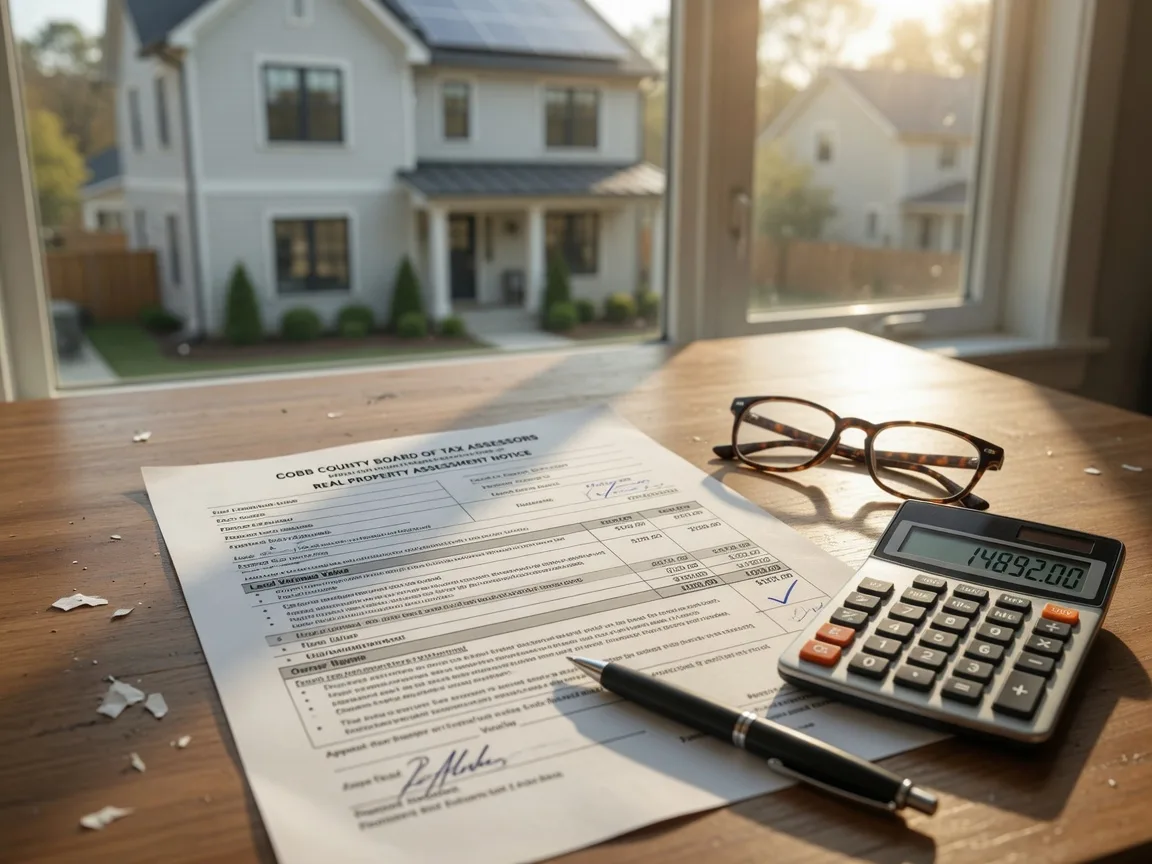
- 2File an appeal within the deadline. You have 45 days from the date of your assessment notice to file an appeal with the Cobb County Board of Tax Assessors. The appeal can be filed online or by mail. You will need to provide evidence supporting your claim that the assessment is too high.
- 3Choose your appeal method. Georgia offers several appeal options: a hearing with the Board of Equalization (a panel of county residents), an appeal to a hearing officer, or binding arbitration. For most homeowners, the Board of Equalization is the simplest and most cost-effective option.
- 4Gather your evidence. The most compelling evidence is recent sales data for comparable homes in your neighborhood. Your real estate agent can help you compile a list of comparable properties. Photographs showing deferred maintenance or needed repairs can also support your case.
We have helped several clients prepare for assessment appeals over the years. If you need help gathering comparable sales data, feel free to reach out.
Real Examples: What Homes at Different Price Points Pay
To give you a concrete picture of what Cobb County property taxes look like for real homes, here are three examples at different price points in unincorporated Cobb County (before exemptions):
$400,000 Home
- Assessed value (40%): $160,000
- Annual tax before exemptions: ~$4,820
- With homestead exemption: ~$4,458
- Monthly tax: ~$372
$500,000 Home
- Assessed value (40%): $200,000
- Annual tax before exemptions: ~$6,026
- With homestead exemption: ~$5,664
- Monthly tax: ~$472
$600,000 Home
- Assessed value (40%): $240,000
- Annual tax before exemptions: ~$7,231
- With homestead exemption: ~$6,869
- Monthly tax: ~$572
Calculations are estimates based on the combined 30.13 millage rate for unincorporated Cobb County. City taxes and exemptions are not included. View the full market report.
One important note: property taxes in Georgia are theoretically capped under the statewide homestead exemption limitation, but the cap is tied to the consumer price index and the original assessed value when you bought the home. This means that long-time homeowners often pay significantly less in property taxes than new buyers of equivalent homes, creating a "tax lock-in" effect that is similar to what you see in states with Proposition 13-style caps.
Final Thoughts
Property taxes in Cobb County are not the lowest in the region, but they buy something real: one of the best public school systems in Georgia, well-maintained parks and infrastructure, and a county government that has managed growth thoughtfully over decades. For most homeowners we work with, the trade-off is a good one.
The most important thing you can do is make sure you are not paying more than you should. File your homestead exemption. Check your assessment notice every year. And if you are 62 or older, apply for the senior exemption. These steps take a few minutes and save you money year after year.
Questions About Your Property Taxes in Cobb County?
Whether you are buying, selling, or just want to understand your tax bill better, we are here to help. Text or call us with your questions.